
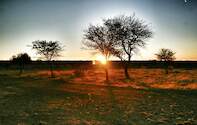
The 4000ha farm is located 85km (52.8 miles) to the east of Gobabis in Namibia, bordering the newly completed tarred road, which links Windhoek and Johannesburg through Botswana.
When you are driving from Johannesburg via Lobatsi, Jwaneng and Kang, a 1000km (11 hour) drive and a 26km (16.1 miles) past the Mamuno border post will get you to your destination. The road is tarred all the way. When driving from Windhoek, via Gobabis a 300km (186.4 miles) drive should take you to your destination also on a tarred road.
In the 'White Sand' Kalahari where the sand is blown and sifted over thousand of years, you will find a place that is harsh and yet able to sustain life in many unique forms found nowhere else on earth. The Kalahari Desert is a vast sandveld region, which extends over central and western Botswana into eastern Namibia and the Northern Cape.
Although generally described as a desert, the typical Kalahari landscape is surprisingly well vegetated. In spring its undulating sandy plains become a flowering wilderness; after Namibia's midsummer rains they become covered in tall green grass and leafy trees, such as Shepherd's tree (Boscia Albetrunca), Camelthorn (Acacia Erioloba), Yellowwood (Terminalia Sericea) and a vast variety of Shrubs.
Getting to Kalahari Bush Breaks
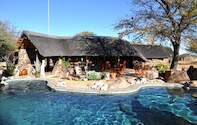
The 4000ha farm is located 85km (52.8 miles) to the east of Gobabis in Namibia, bordering the newly completed tarred road, which links Windhoek and Johannesburg through Botswana.
When you are driving from Johannesburg via Lobatsi, Jwaneng and Kang, a 1000km (11 hour) drive and a 26km (16.1 miles) past the Mamuno border post will get you to your destination. The road is tarred all the way.
When driving from Windhoek, via Gobabis a 300km (186.4 miles) drive should take you to your destination also on a tarred road.
